
If you take a haunted tour of Charleston, South Carolina, you will likely hear the story of Lavinia Fisher, often called America’s first female serial killer.
According to the legend, in the early 1800s, Lavinia and her husband, John Fisher, owned an inn called the Six-Mile Wayfarer House, about six miles outside Charleston. The inn was a popular stopping place for travelers and merchants making their way into the city.
Lavinia supposedly had a particular talent for making male travelers feel welcome. She was said to be very beautiful and charming, and was supposedly well-liked among the people in the area.
She would ask the travelers whether they had family, where they were going, and what they were carrying with them. Then, according to the story, she would offer them a cup of tea laced with oleander.
The traveler would eventually retire for the night, unaware of what the Fishers supposedly had planned. The bed in his room was said to be rigged so that it could drop through the floor into a pit beneath the house. If the poison or the fall didn’t kill him, John Fisher would finish the job.
As stories of missing travelers and robberies along the road began to circulate, one traveler supposedly became suspicious enough and was able to escape the Fishers’ trap.
According to the story, John Peeples stopped at the Six-Mile House looking for a room. Lavinia initially told him there wasn’t one available, but invited him to rest and have a meal. During the meal, she began asking him personal questions about his travels, his family, and what he was carrying.
Peeples became suspicious of Lavinia’s questions.
After the meal, Lavinia disappeared for a while. When she returned, she told him that she had found a room for him after all and offered him a cup of tea.
Peeples accepted the room but didn’t like tea. Not wanting to be rude, he secretly disposed of the tea. When he was shown to his room, he decided not to sleep in the bed. Instead, he spent the night sitting in a chair.
Sometime during the night, a noise startled him awake.
The bed was gone, it had dropped through the floor.
Scared for his life, Peeples escaped through the window and rode to Charleston to alert authorities.
It’s a great story, but when we look at the historical record, the events surrounding the Fishers looks quite different.
There really was trouble along the road, and there really was a violent confrontation involving the Fishers and other people staying at the Six-Mile House. However, it was reported that travelers would be swindled out of their money while gambling at the inn, or, in some instances, robbed.
By February 1819, a vigilante mob had formed.
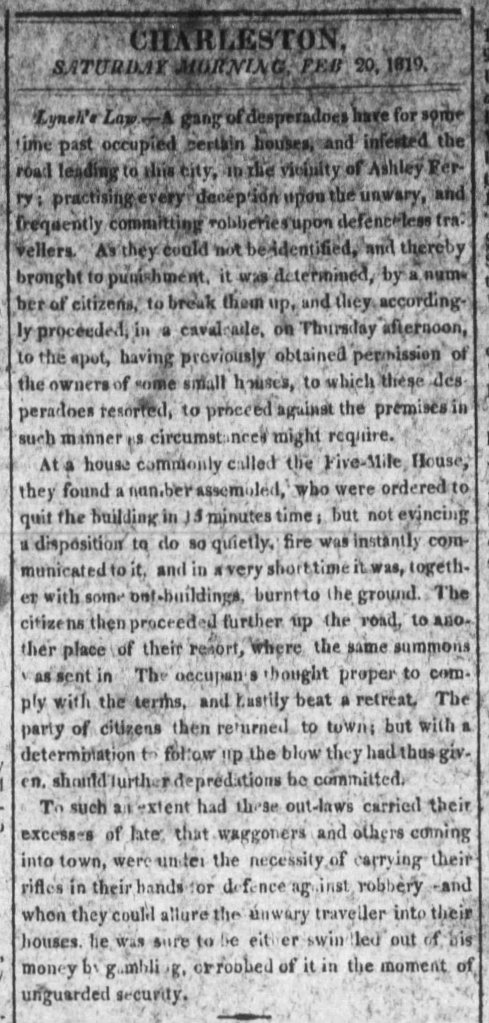
The mob first went to the Five-Mile House, another inn located about a mile down the road. When the people inside refused to leave, the mob set fire to the building, forcing them out.
The inn burned to the ground.
The mob then continued down the road to the Six-Mile House. The Fishers and the other occupants were ordered to leave or face the same fate. They left, and by morning, most of the mob had returned to Charleston. One man, David Ross, stayed behind to keep watch over the property.
It didn’t go well.
After the mob left, the occupants of the Six-Mile House reportedly returned and attacked Ross. He managed to escape and make his way back to Charleston.
After hearing Ross’s account, the sheriff gathered a group of men and went to the Six-Mile House. The Fishers and several others reportedly connected to their criminal group were arrested and taken to the Charleston City Jail.
And this is where the story gets even more interesting.
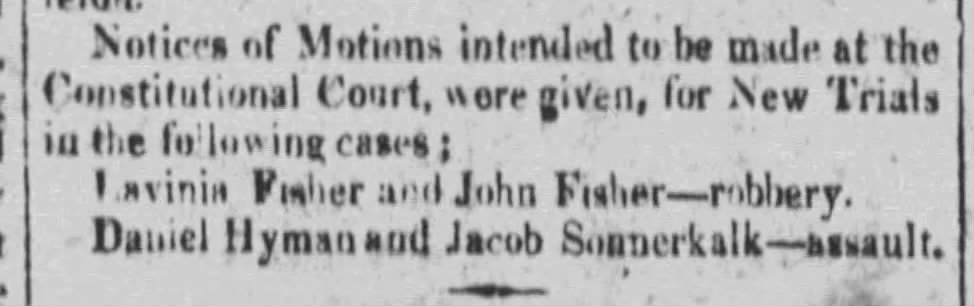
The Fishers really were involved in crime. They were accused of swindling travelers and participating in highway robbery. But they were not convicted of murdering their guests.
And when the sheriff’s men searched the Six-Mile House and its outbuildings before burning it all down, there was no reported pit filled with bodies beneath the inn.
There were, however, two graves nearby.
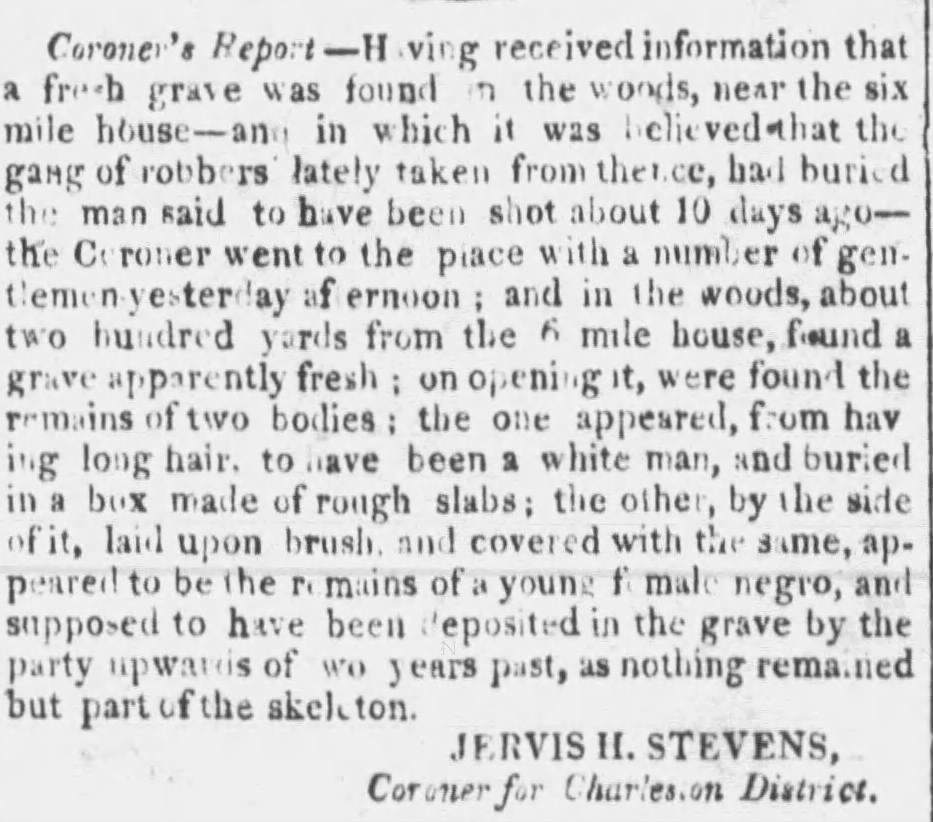
On February 26, 1819, The Charleston Daily Courier reported that a fresh burial had been discovered about 200 yards from the Six-Mile House. When the grave was investigated, they found the body of a man in a rough coffin. He had been shot and buried about ten days earlier.
Nearby was another grave, apparently belonging to a young Black woman who was estimated to have been buried about two years earlier.
Were they victims of the Fishers or the people associated with them?
We don’t know.
The graves were real. The Fishers’ criminal activities were real. But there isn’t enough evidence to connect those two people to Lavinia and John, and the Fishers were ultimately convicted of highway robbery rather than murder.
Even the story of John Peeples doesn’t quite survive intact.
There is no evidence in the contemporary newspaper accounts that Peeples spent the night at the Six-Mile House, drank poisoned tea, or watched a bed disappear through the floor.
There is, however, evidence that a man named John Peeples gave a deposition identifying the Fishers as part of a group that assaulted and robbed him near the Six-Mile House. An account of his testimony, though not his name, appeared in The Charleston Daily Courier on February 22, 1819.
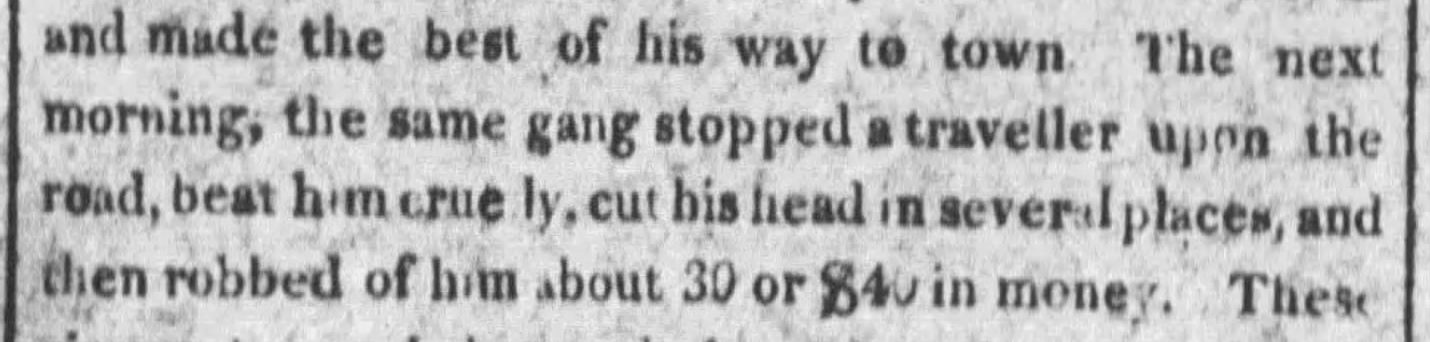
So there may have been a real John Peeples in the story.
But the man who escaped through the bedroom window after watching his bed drop into a pit appears to belong to the legend.
And then there is the story of Lavinia’s final moments.
According to the legend, Lavinia refused to believe she could be hanged because she was a married woman. She supposedly arrived at the gallows wearing her wedding dress. The judge ordered John to be hanged first, making Lavinia a widow and allowing her sentence to be carried out. She then had to be carried to the scaffold, where she supposedly told the crowd:
“If anyone has a message to send to hell…I’ll carry it.”
It’s a dramatic ending.
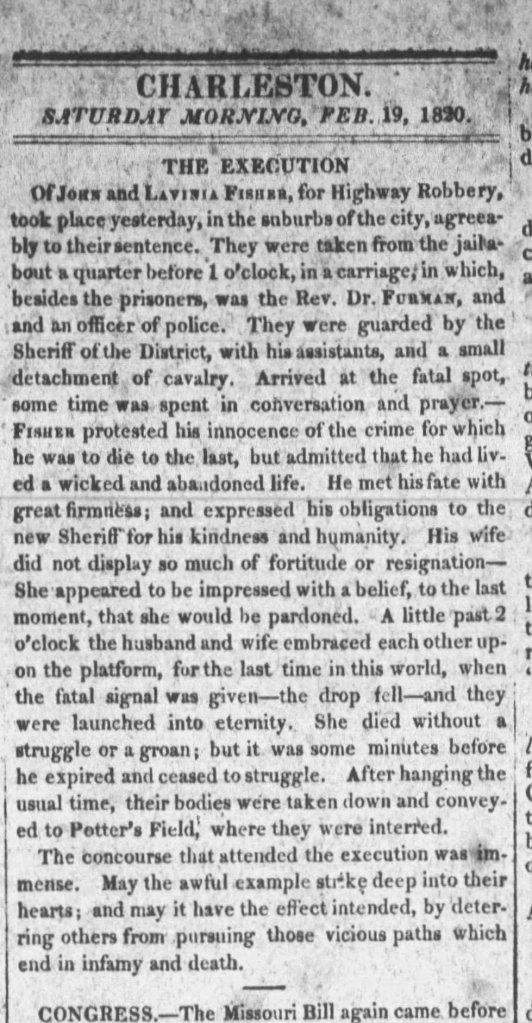
But once again, the historical record tells us something different.
Lavinia didn’t have to be carried to the gallows and she wasn’t wearing a wedding dress. Contemporary newspaper accounts reported that Lavinia appeared to believe she would be pardoned, even as the execution approached.
The pardon never came.
After spending roughly a year in Charleston City Jail, Lavinia Fisher was led to the gallows alongside her husband.
They were hanged together.
The legend remembers a monster.
The historical record leaves us with something much more complicated: a real woman who committed crimes, spent a year in jail waiting for a pardon that never came, and was hanged alongside her husband for highway robbery.
Somewhere along the way, Lavinia Fisher became America’s first female serial killer.
But the woman behind the legend is a little harder to find.
Sources
Coroner’s Report. (1819, February 26). The Charleston Daily Courier. p 2.
[A Gang of Desperadoes]. (1819, February 20). The Charleston Daily Courier. p 2.
The Execution. (1820, February 19). The Charleston Daily Courier. p 2.
Execution. (1820, February 18). The Charleston Daily Courier. p 2.
[John Fisher, and Lavinia, his wife, who were convicted of highway robbery]. (1820, January 18). The Charleston Daily Courier. p 2.
Wise, W.L. (2019, October 30). Lavinia Fisher of Charleston: Nation’s first female serial killer or wrongly accused? The Post and Courier. https://www.postandcourier.com/news/lavinia-fisher-of-charleston-nations-first-female-serial-killer-or-wrongly-accused/article_8cd5c8da-e60f-11e9-abd7-0712bc94dd35.html
Lavinia Fisher: The First Female Serial Killer. Thescarechamber.com. https://thescarechamber.com/lavinia-fisher/amp/?utm_source=chatgpt.com


Leave a comment